Why building more housing choices—and better communities—matters just as much as building cheaper homes.
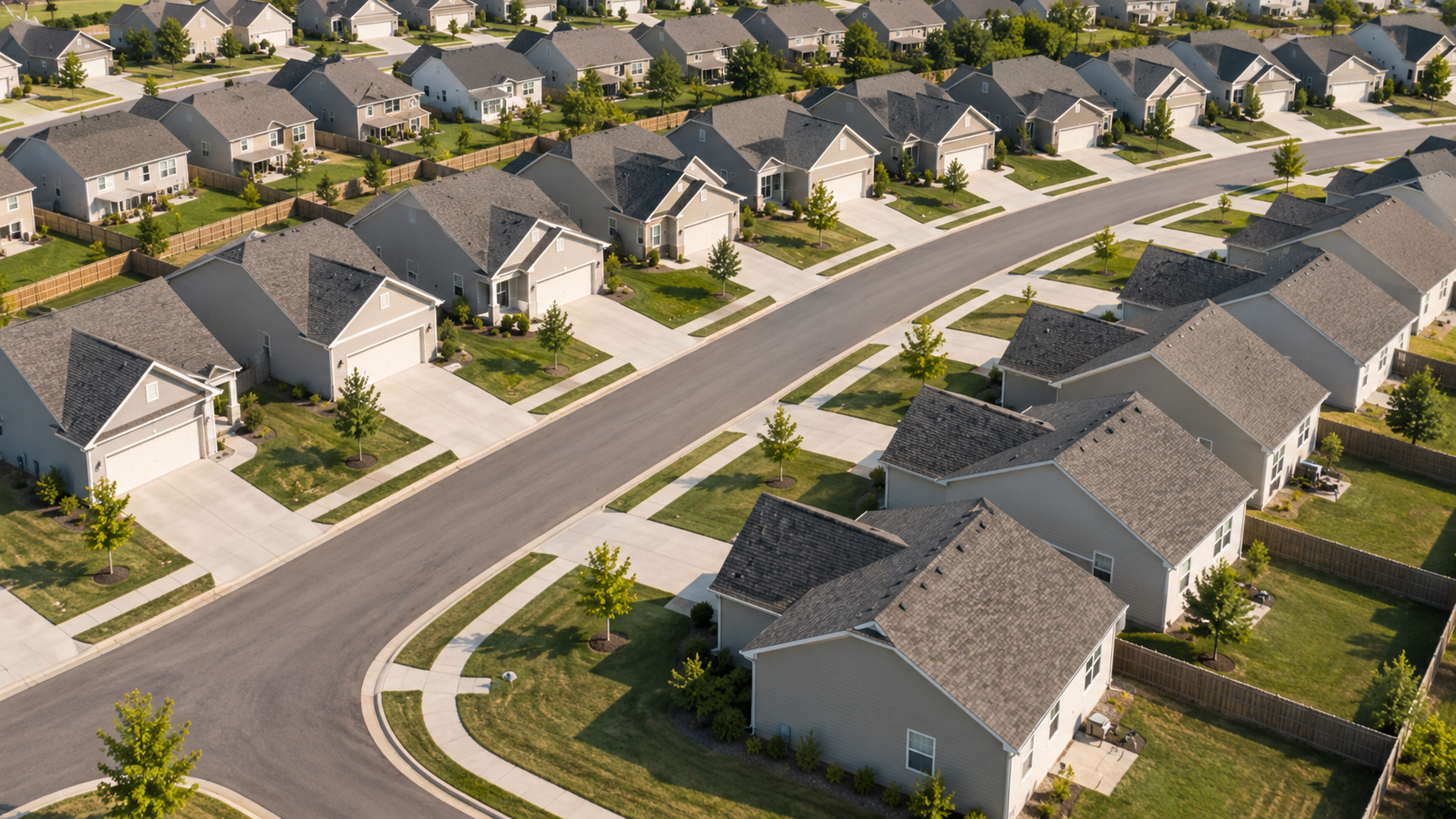
America's housing affordability crisis has been decades in the making, and rising development costs have only compounded the problem. Particularly since the 2008 financial crisis, construction costs, land prices, regulatory requirements, and infrastructure expenses have made it increasingly difficult to deliver new homes at attainable prices.
At the same time, we face a fundamental housing supply shortage. We need to build more homes to meet demand, but today's developers face a dramatically different financial and regulatory landscape than the one that produced much of our existing housing stock. Building a new home at a price competitive with older housing is increasingly difficult.
This helps explain the prevalence of the term "builder grade" in conversations about new construction. In an effort to reach attainable price points, developers often prioritize inexpensive materials, finishes, and construction methods that meet minimum code requirements. While these choices can reduce the initial purchase price, they can sometimes come at the expense of durability, sustainability, and long-term value.
And that's an important distinction, particularly for lower-income households stretching their finances to achieve homeownership. The purchase price of a home is only one part of what it actually costs to own it. Utility bills, maintenance, repairs, replacement cycles, and ongoing upkeep can have an equally meaningful impact on a household's financial stability.
If we're serious about affordability, we need to think beyond the sales price and consider the full cost of homeownership over time.
The Myth of the Cheap Housing Type

Through our work at MicroLife, and conversations with developers working across a variety of housing types, we've come to recognize an uncomfortable reality: there is no magic housing configuration that automatically makes new construction affordable.
In our experience, when comparing homes of similar quality, materials, and construction standards, the difference in total development costs on a per-unit basis can be surprisingly modest across housing types like smaller single-family homes, cottage courts, townhomes, and certain multifamily configurations. These are observations rather than universal rules, and the economics of individual projects can vary substantially. But they challenge a common assumption that simply changing the housing type will dramatically reduce the cost of delivering each home.
Each configuration has its own efficiencies and tradeoffs.
Increasing density allows developers to spread land and infrastructure costs across more homes. But different building types introduce new expenses. Cottage courts and townhome developments still require parking, utilities, and stormwater infrastructure, often without enough units to distribute those costs efficiently. Larger multifamily buildings can spread those expenses across many more units, but may introduce additional requirements for fire protection, structural systems, shared circulation, elevators, and other building components that offset some of those savings.
The broader lesson is that density can improve land efficiency without necessarily producing a proportional reduction in the cost of each home.
And when affordability becomes the singular objective, the most obvious path to reducing costs is often to eliminate anything that isn't strictly necessary.
But what happens when we start eliminating the very things that make a place desirable?
Affordability at What Cost?
There are organizations and developers that have built successful models around delivering housing at the lowest possible cost.
Habitat for Humanity is perhaps the best-known example in the nonprofit sector. Through volunteer labor, donated materials, philanthropic support, and other nontraditional resources, Habitat can reduce development costs and make homeownership possible for families who might otherwise be excluded from the market.
In the private sector, large production builders like D.R. Horton and Lennar achieve efficiencies through standardized designs, purchasing power, and economies of scale. These approaches can make new homes more financially accessible than they might otherwise be.
And there's absolutely a place for these models. Different households have different priorities, and for many buyers, a conventional single-family home with a private yard and driveway is exactly what they're looking for.
But the pursuit of cost efficiency can also come with tradeoffs in how neighborhoods are designed.
Front porches become optional. Shared green spaces are reduced or eliminated. Homes are arranged around driveways and garages rather than pedestrian connections. Outdoor space becomes an individual responsibility rather than a shared community asset.
None of these decisions is inherently wrong. They reflect a particular set of priorities, and those priorities may work well for many households. But they raise a question worth asking:
Should our goal be simply to build the least expensive homes possible, or to build places that offer the greatest value to the people who live there?

Those aren't necessarily the same thing.
And perhaps more importantly, shouldn't we be building a greater variety of places to accommodate the equally diverse needs and preferences of the people who live in them?
The Complications of Missing-Middle Homeownership
At MicroLife, we believe strongly in the potential of missing-middle housing: duplexes, triplexes, fourplexes, townhomes, cottage courts, and accessory dwelling units that introduce additional homes without fundamentally overwhelming the scale of existing neighborhoods.
But for organizations focused on creating homeownership opportunities rather than exclusively rental housing, some of these building types introduce another layer of complexity.
Consider a triplex or fourplex. While it may be an excellent way to add gentle density, the building is often owned as a single property. That means one buyer must purchase the entire building and effectively become a landlord—a considerably narrower buyer profile than someone purchasing an individual home.
Alternatively, the units can sometimes be divided into condominiums, allowing individual ownership. But that introduces shared maintenance responsibilities for roofs, exterior walls, building systems, insurance, and other common elements. In a building with only three or four owners, those costs can translate into relatively substantial monthly association fees and financial exposure. Condominium financing and project eligibility requirements can also create additional hurdles for buyers.
These challenges are part of why MicroLife places such importance on fee-simple homeownership wherever possible. We want buyers to own their homes with straightforward financing, predictable maintenance responsibilities, and manageable ongoing costs.
That preference influences the types of developments we pursue, even when other housing configurations might appear more efficient on paper.
So Why Cottage Courts?
If cottage courts aren't necessarily dramatically cheaper to build than modest single-family homes or other missing-middle housing types, why are we so committed to them?
Because we believe their value goes well beyond construction cost.
Not everyone wants to live in a cottage court. Some households need more space, prefer greater privacy, or simply value having their own large yard. Those are perfectly legitimate preferences, and conventional single-family neighborhoods will continue to serve an important role in our housing landscape.
But there is also a substantial and often underserved population looking for something different: smaller homes, less maintenance, stronger neighborhood connections, shared amenities, and the ability to live in walkable communities.
The problem isn't that we've been building the wrong type of housing for everyone. It's that we've built so much of one type that we've left too few options for everyone else.
Cottage courts are one way to help address that imbalance.
1. A Better Balance Between Density and Neighborhood Character
We need to use land more efficiently. That is fundamental to addressing our housing shortage.
But density doesn't have to mean dramatically changing the character of a neighborhood.
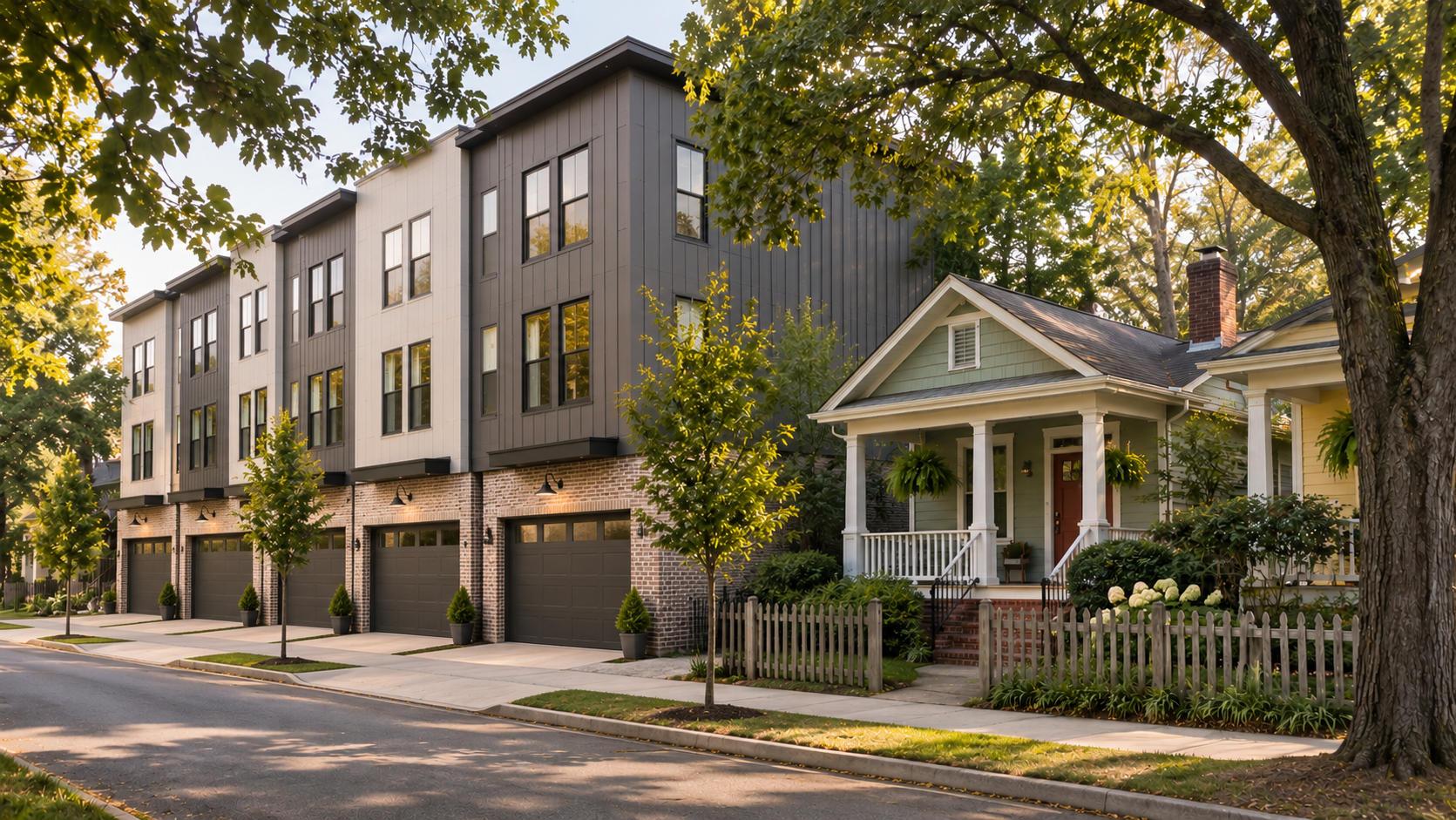
A continuous row of three-story townhomes may feel out of scale in a historic neighborhood of smaller houses. A thoughtfully designed collection of cottages can introduce additional homes while maintaining a familiar residential scale.
Cottage courts allow us to increase housing supply without necessarily overwhelming the neighborhoods around them. They offer a middle ground between conventional suburban lots and larger multifamily buildings, particularly in areas already served by municipal water, sewer, and other infrastructure.
This doesn't mean townhomes or larger multifamily buildings are inherently inappropriate. In many locations, they're exactly the right solution. The point is that communities benefit from having more tools available to respond thoughtfully to different sites and neighborhood conditions.
It's about adding to a neighborhood rather than overpowering it.
2. Lower Lifetime Ownership Costs
For a household of one or two people, a smaller home can offer something particularly valuable: all the space they need, without paying to build, heat, cool, maintain, and repair space they don't.
Smaller footprints generally mean lower utility consumption, fewer materials to maintain, and reduced long-term upkeep. Smaller private yards also mean less time and money spent on landscaping.
This can be especially meaningful for older homeowners looking to age in place, or households that want access to outdoor space without the responsibility of maintaining a large property.
A cottage court provides access to gardens, gathering areas, and shared green space while distributing the responsibilities of maintaining those amenities across the community. Those shared amenities still carry maintenance costs, but the responsibility is distributed rather than falling entirely on individual homeowners.
Affordability isn't just about what it costs to buy a home. It's also about what it costs to live there for the next 20 or 30 years.
3. A Lifestyle Designed Around Community
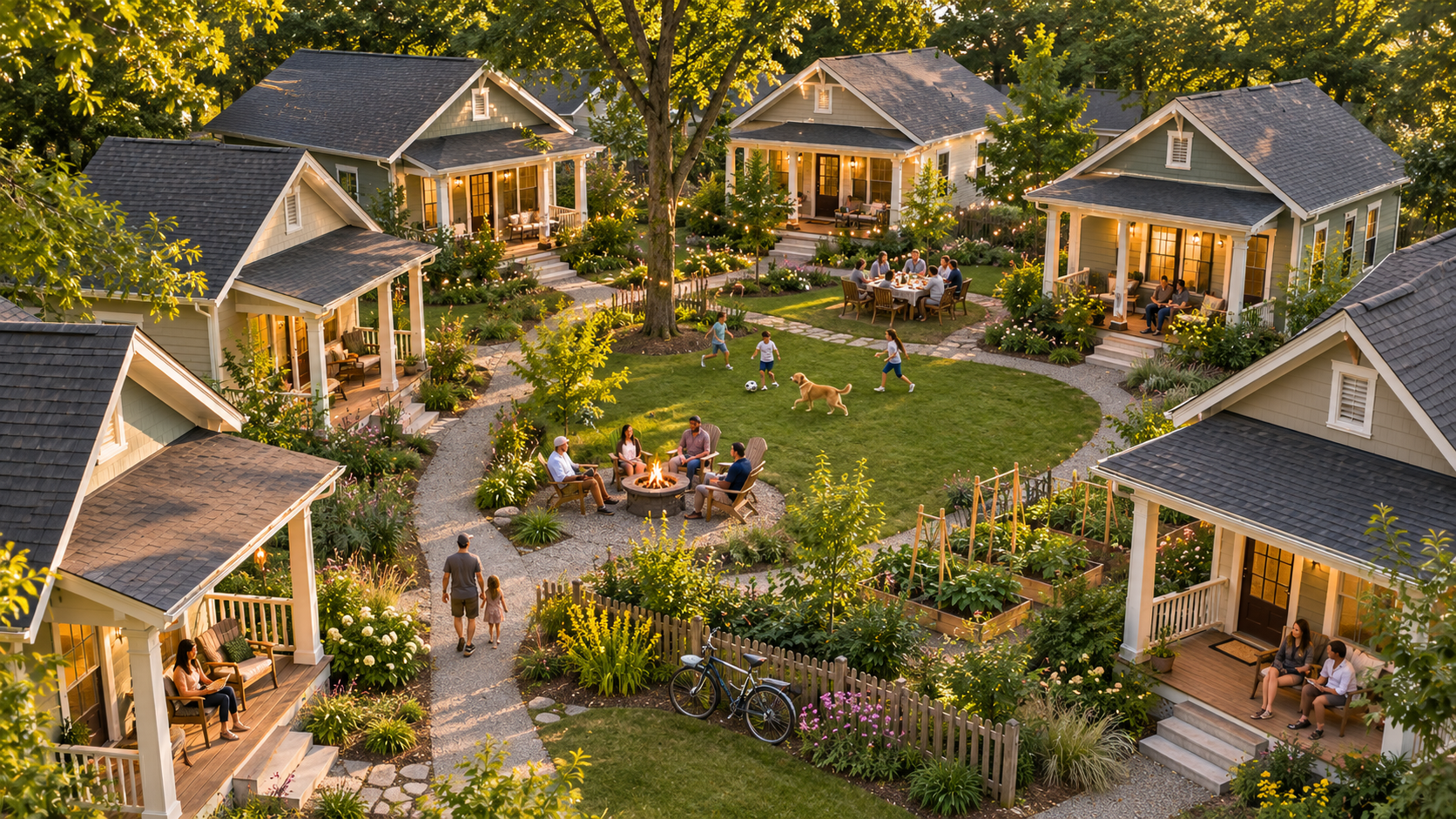
Traditional suburban housing tends to emphasize the individual lot. Cottage courts shift some of that emphasis toward the spaces between homes.
The arrangement is intentional.
Private interiors provide personal space. Shared courtyards create opportunities for gathering. Front porches establish a comfortable transition between the two—a place to participate in community life without necessarily leaving home.
These environments encourage the small, spontaneous interactions that help relationships develop: a conversation while walking the dog, children playing together in the courtyard, neighbors sharing a cup of coffee on the porch.
We also believe the scale of these communities matters. By keeping the number of homes around a shared courtyard relatively small, residents have a greater opportunity to know one another, participate in decisions, and develop a sense of collective responsibility.
Of course, not everyone wants this degree of interaction with their neighbors, and that's fine. But for those who do, housing options that intentionally encourage it remain surprisingly limited.
Architecture alone doesn't create community. But it can establish the conditions that make community more likely to flourish.
4. Designing for People, Not Just Cars
Much of conventional suburban development is organized around the automobile. Roads, driveways, and garages establish the layout, and pedestrian life is accommodated within whatever space remains.
We prefer to reverse that relationship.
In a cottage court, homes and shared pedestrian spaces establish the community's structure. Parking is still provided, but it doesn't dominate the experience of living there.
This approach is especially valuable in walkable neighborhoods where residents can reach parks, shops, restaurants, schools, or transit without relying on a car for every trip.
Leaving home shouldn't always mean walking directly to a vehicle. It should also mean having the option to walk to a park, bike to a coffee shop, or simply run into a neighbor along the way.
Not every site can provide that level of connectivity, and many households will continue to depend on cars. But where opportunities exist to make walking and biking easier, we believe housing design should help encourage them.
These everyday experiences contribute to healthier, more connected neighborhoods and can reduce household transportation expenses—another important component of overall affordability.
Rethinking What Makes Housing Desirable
One of the assumptions we're particularly interested in challenging at MicroLife is that cottage courts and other missing-middle housing types represent a compromise.
The conventional thinking goes something like this: buyers would naturally prefer a larger detached home, a private driveway, and a big yard. Smaller homes with shared outdoor spaces must therefore be a lesser product, justified primarily by a lower price.
For some buyers, that may be true. But for others, a smaller home with access to shared amenities and a more connected neighborhood might actually be preferable.
What if these development patterns aren't simply an affordable alternative to conventional suburban housing, but a more desirable way to live for a significant portion of the population?
There are plenty of examples suggesting that people place a premium on thoughtfully designed, walkable, community-oriented neighborhoods.
Places like Seaside and other communities along Florida's 30A corridor, traditional New England villages, and Ross Chapin's pocket neighborhoods in the Pacific Northwest demonstrate the enduring appeal of human-scaled environments. Closer to home, Georgia communities like Serenbe and Trilith have built strong identities around walkability, shared amenities, and a sense of place.
These communities aren't affordable. In fact, many command significant premiums.
But that's precisely what makes them instructive.
People are willing to pay for places that offer something beyond square footage: beauty, connection, convenience, shared experiences, and a sense of belonging.
We see this in the places people choose to visit on vacation. We seek out walkable main streets, charming cottages, lively public spaces, and neighborhoods where we can spend an afternoon without getting into a car.
Then we return home to development patterns that rarely offer those same qualities.
Why should the places we love to visit feel so different from the places we build to live?
The Challenge of Balancing Affordability and Livability
This brings us back to one of the central challenges of MicroLife's work.
We are committed to creating more affordable and attainable homeownership opportunities. But we're equally committed to thoughtful architecture, shared community spaces, human-scaled design, and financially sustainable development.
Those priorities don't always align neatly.
We could eliminate front porches to reduce construction costs. We could shrink courtyards to fit more units. We could prioritize the least expensive materials and simplify every design decision around the lowest possible sales price.
And in some cases, those decisions might help more families access homeownership.
But at a certain point, we would be sacrificing the qualities that make these communities worth building in the first place.
There's also a larger financial reality we have to acknowledge:
at today's development costs, achieving genuinely affordable homeownership prices for income-qualified households often requires subsidy, regardless of the housing type.
This isn't a problem unique to cottage courts. Conventional single-family homes, townhomes, and multifamily developments all face the same fundamental challenge. When the cost of delivering a new home exceeds what an income-qualified buyer can afford to pay, someone or something has to bridge that gap.
Sometimes that comes through public funding, grants, donated land, philanthropic contributions, cross-subsidies from market-rate homes, or other forms of financial assistance. Sometimes it comes through a combination of these approaches.
No amount of thoughtful site planning can entirely eliminate that mathematical reality.
But for MicroLife, public and philanthropic support can serve another important purpose beyond closing the affordability gap.
It allows us to demonstrate housing models that conventional development financing may be reluctant to support.
Traditional private development capital tends to favor established housing products with predictable comparable sales and demonstrated profit margins. A cottage court that costs roughly as much to build as a conventional subdivision, but introduces a less familiar ownership model and development pattern, can be difficult to underwrite.
Without a clear cost advantage or evidence of stronger sales performance, investors may see the model as an unnecessary risk.
Grants and other forms of patient capital can help us overcome that initial hurdle. They give us the opportunity to build projects, demonstrate demand, establish comparable sales, and prove that these communities can be both desirable and financially viable.
Our goal isn't to rely on subsidies indefinitely to support a particular architectural concept. It's to demonstrate that these housing types can become viable, repeatable development models in their own right, while recognizing that serving lower-income buyers will continue to require the same kinds of affordability support needed across the housing industry.
In that sense, our pilot projects serve two purposes: delivering homes that are attainable to the households we're trying to reach, and helping establish a broader market for housing choices that have historically been overlooked.
Building Toward a Different Definition of Value
Projects like our Cottages on Vaughan are about more than delivering a particular number of homes at a particular price.
They're an opportunity to challenge assumptions about what people want from housing, what makes a neighborhood successful, and how we should measure the value of residential development.
We don't believe that smaller homes, shared outdoor spaces, or reduced emphasis on cars should automatically be viewed as sacrifices made in the name of affordability.
For many people, they may actually be improvements.
That doesn't mean cottage courts are the answer to every housing challenge, or that everyone should aspire to live in one. Quite the opposite. We believe a healthy housing market should offer a much broader range of choices than the relatively narrow set of development patterns we've come to rely upon.
Some people want a large house and a private yard. Others want an apartment in a vibrant urban neighborhood. Still others want a modest home, a front porch, and a shared courtyard where they know their neighbors.
All of those preferences deserve a place in our housing landscape.
And we believe that, with the right policies, infrastructure investments, financing tools, and development practices, we can make a greater diversity of housing options accessible to far more households.
The challenge is getting there without stripping away the qualities that make each of those options valuable.
Affordable housing should be about more than making homes cheaper. It should be about making a good life more attainable—and giving people more choices in what that life looks like.
That's the balance we're working to achieve at MicroLife, and the premise we hope our projects will help prove.